
Jump Ring Sizes Chart: Gauge, mm and How to Open and Use Jump Rings
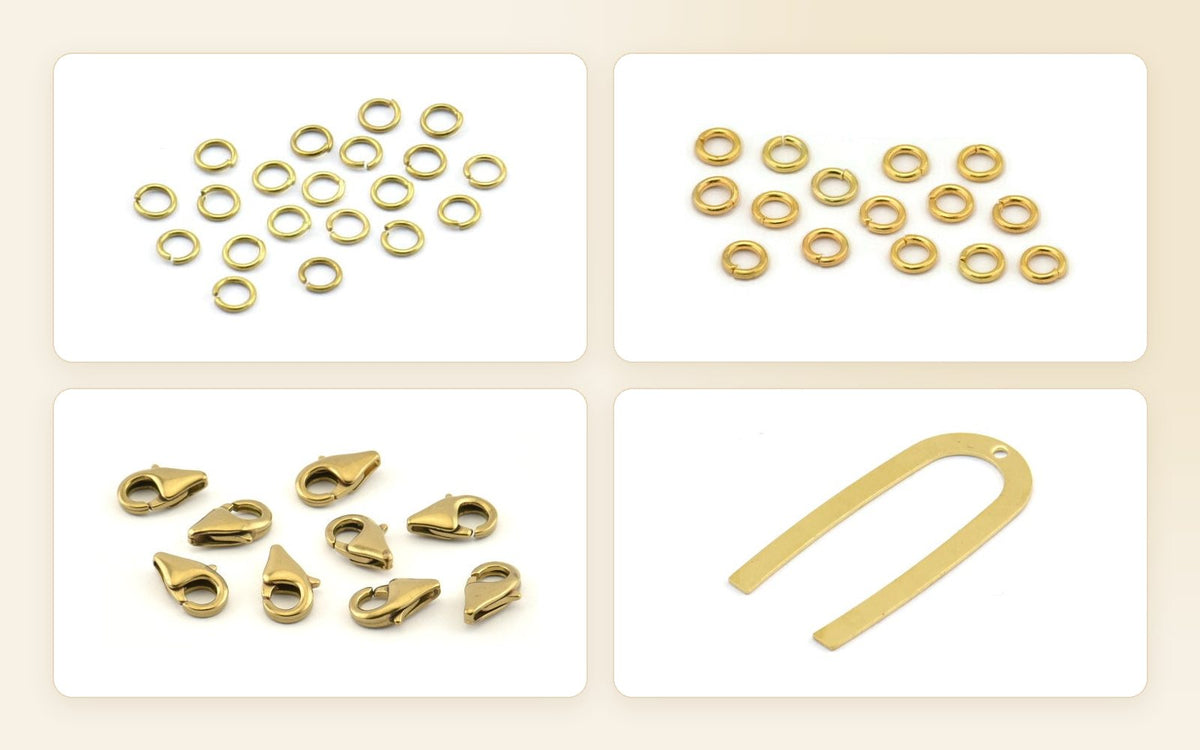
Jump rings are measured by diameter (usually outer diameter, in mm) and wire thickness (gauge or mm). For most jewelry, 4–6 mm rings in 0.7–0.8 mm (20–21 gauge) wire are the go-to size. To open one, hold it with two pliers and twist one side toward you, never pull it apart.
How jump rings are measured
- Outer diameter (OD): the full width across the ring. Most listings, including ours, give this. For example, "6 mm jump ring" means 6 mm across.
- Inner diameter (ID): the hole size, which is OD minus twice the wire thickness. Important when the ring has to pass through a chain link or a charm loop.
- Wire thickness: in gauge (AWG in the US) or in mm. A higher gauge number means a thinner wire.
Gauge to mm chart
| Gauge (AWG) | mm | Typical use |
|---|---|---|
| 24 | 0.51 | Very fine chains, tiny charms |
| 22 | 0.64 | Delicate charms, fine necklaces |
| 21 | 0.72 | Earrings, light pendants |
| 20 | 0.81 | All-purpose: charms, clasps, bracelets |
| 18 | 1.02 | Heavier pendants, charm bracelets, chain maille |
| 16 | 1.29 | Chunky chains, keychains, bag charms |


Which jump ring size to use
| Job | Suggested size |
|---|---|
| Small charms on earrings | 3–5 mm, 0.6–0.7 mm wire |
| Attaching a clasp to chain | 4–5 mm, 0.7–0.8 mm wire |
| Pendants on necklaces | 5–7 mm, 0.8–1.0 mm wire |
| Charm bracelets | 5–7 mm, 0.8–1.0 mm wire |
| Keychains, bag charms, chunky pieces | 8–12 mm, 1.0–1.5 mm wire |
How to open and close a jump ring
- Hold the ring with the opening at the top (12 o'clock).
- Grip each side with a pair of chain-nose or flat-nose pliers.
- Twist one hand toward you and the other away, opening the ring like a door. Do not pull the ends apart sideways; that warps the circle and weakens the metal.
- Thread on your charm, chain or clasp.
- Twist back the same way. Push slightly past closed and back again so the ends meet flush with no gap, and you will feel or hear them click together.
Making jump rings stronger
- Use thicker wire for heavier pieces; thin rings can be pulled open.
- Choose a smaller ring for the same wire, since smaller rings in the same wire are stiffer.
- Double up: use two jump rings side by side for heavy pendants.
What else can you do with jump rings?
Jump rings connect almost everything: charms to ear wires, clasps to chain, connectors to each other, and pendants to necklaces. You can also weave them together into chain maille. Start with How to Make Jewelry if you are new.
Frequently asked questions
What is the most common jump ring size?
Around 5–6 mm outer diameter in 20 gauge (0.8 mm) wire.
Are jump rings measured inside or outside?
Usually outside diameter. Some chain maille suppliers list inner diameter, so check the listing.
How do I keep jump rings from opening?
Close them flush, use thicker wire, or use two rings for heavy pieces.
Shop Jump Rings for Jewelry
View all →


More jewelry making guides
All guides →
How to Stamp Metal Jewelry: A Beginner's Guide to Stamping Blanks
Metal stamping needs steel letter stamps, a 1–2 lb hammer, a steel bench block and soft-metal blanks like brass or copper. Strike...

Types of Earring Hooks and Ear Wires (and How to Make Your Own)
Fish hooks (French wires) are the most common earring hooks; leverbacks and kidney wires are the most secure; hoops, threaders and shepherd...

How to Make a Charm Bracelet: Step-by-Step Guide
A charm bracelet is a chain sized to your wrist plus half an inch, a lobster clasp, and charms attached every few...